

How renewable energy is reshaping the economics of farming across Kenya, Uganda, Tanzania, and beyond
The Pressure Beneath the Surface
Across East Africa, the agricultural sector is facing a quiet but severe pressure test. For the past year, soaring fuel prices and volatile electricity tariffs have steadily chipped away at agribusiness margins. From grid-tied irrigation systems to diesel-powered crop processors, the cost of keeping a farm running has become a major roadblock to food security and regional trade.
The numbers are stark. Diesel prices in Kenya surpassed KES 200 per litre in 2023 and have remained volatile since, while Uganda and Tanzania have faced similar fuel cost shocks driven by global crude oil pricing, currency depreciation, and import logistics pressures. For smallholder farmers operating on thin margins — who may spend 30 to 40 percent of their operational budget on energy inputs — these increases are not just inconvenient. They are existential.
The consequences ripple outward. Irrigated farmland goes unwatered. Cold storage units are switched off to save costs, accelerating post-harvest losses that already consume an estimated 30 to 40 percent of produce in sub-Saharan Africa before it reaches market. Milling and processing operations run reduced hours or cease altogether. What began as a cost problem has quietly become a food security crisis in slow motion.
A Shift on the Ground
However, a shift is happening on the ground. Forward-thinking MSMEs and smallholder farmers are aggressively pivoting toward decentralized solar kits and solar-powered irrigation systems. What began as a conversational trend in sustainability has rapidly evolved into an economic necessity.
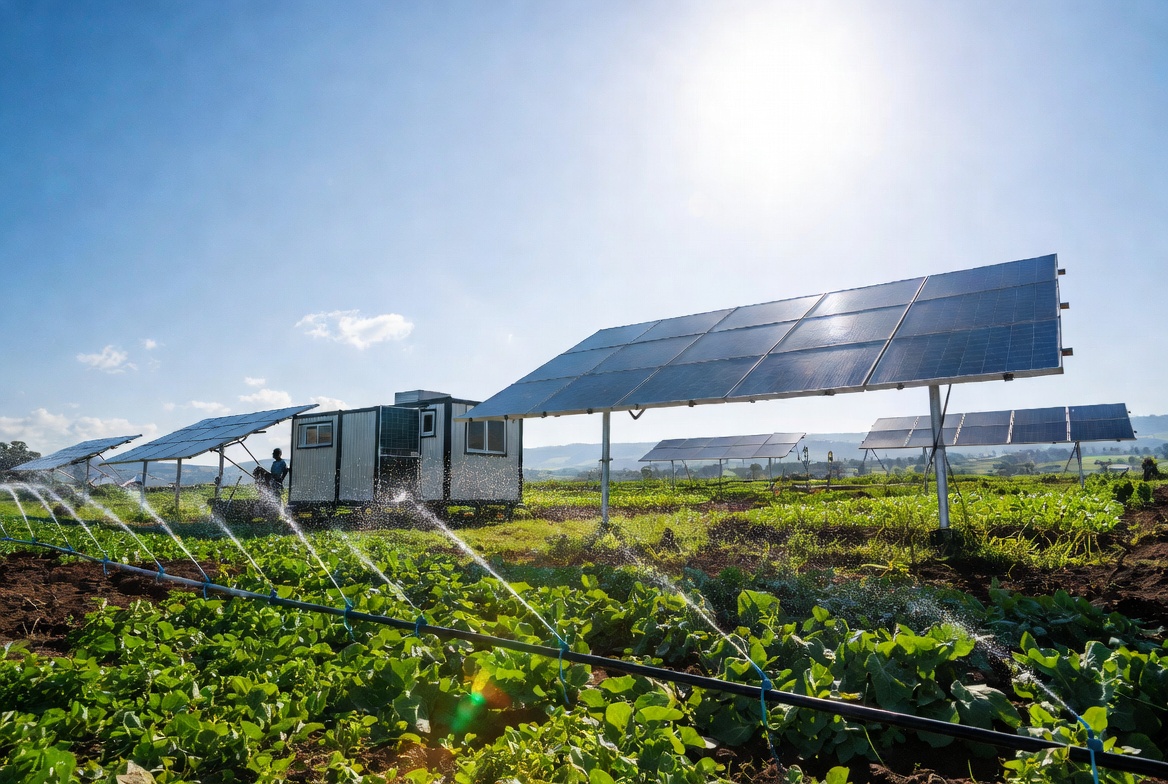
In the Rift Valley counties of Kenya, solar-powered water pumps are now a common sight on vegetable farms that once ran entirely on diesel-fed generators. In the lake regions of Uganda, fishing cooperatives are investing in solar cold rooms to extend the shelf life of their catch and access distant urban markets for the first time. In Tanzania’s Morogoro region, agro-processors are installing hybrid solar-battery systems to stabilize their operations against the unreliable national grid.
These are not technology pilots or donor-funded experiments. Increasingly, they are commercially driven investments made by farmers and agribusiness owners who have run the numbers and found that solar pays.
A typical solar-powered drip irrigation system serving one to three acres can be installed for between USD 1,500 and USD 4,000, depending on pump capacity and panel configuration. Against diesel costs that can exceed USD 300 to USD 500 per month for equivalent water output, the payback period in many cases falls between 18 and 36 months — after which the energy input is essentially free. For a smallholder farmer operating on a five-year planning horizon, that is a compelling proposition.
Democratizing the Farm’s Infrastructure
By eliminating reliance on erratic national grids and expensive diesel, solar technology is democratizing irrigation and cold-chain storage — tools that were once the exclusive domain of large-scale commercial farms.
Drip irrigation, for instance, has long been recognized as one of the most water-efficient and yield-boosting technologies available to African agriculture. Yet its adoption among smallholders has historically been constrained not by a lack of knowledge, but by the prohibitive cost of powering pumps. Solar removes that barrier. A smallholder with a two-acre plot can now access the same precision irrigation that a 500-acre commercial farm uses, powered by panels that require minimal maintenance and no fuel supply chain.
The cold-chain story is equally transformative. East Africa loses billions of dollars annually to post-harvest spoilage, a loss that falls disproportionately on smallholders who lack access to refrigerated transport or storage. Solar-powered cold rooms — many now available in modular, containerized units — are beginning to change this calculus. Community-level cold hubs, where multiple smallholders share refrigerated storage powered by rooftop solar, are emerging in peri-urban and market-adjacent areas across Kenya and Rwanda.
The impact extends beyond simple cost savings. Access to cold storage changes the entire economics of farming. A farmer who can hold produce for two weeks rather than selling immediately at harvest has leverage in price negotiations. They can wait for better market prices, reduce food loss, and build a more predictable income stream. Solar cold-chain is, in a very real sense, a financial instrument as much as it is a physical one.
The Role of Finance: Making Solar Accessible at Scale
Technology alone does not transform an industry. Finance does. And this is where East Africa’s solar-agri-tech story is entering its most important chapter.
Financial institutions — from development finance institutions and microfinance providers to tier-one commercial banks — are increasingly designing specialized asset-financing structures and agri-tech loan products tailored to the economics of solar farm equipment.
These products acknowledge a fundamental truth: a solar irrigation pump or cold room is productive collateral. Unlike a general-purpose loan, an agri-tech loan for solar equipment can be structured against the demonstrable cash flow savings the equipment generates. A farmer who replaces a diesel pump with a solar alternative is, in effect, redirecting former fuel expenditure toward loan repayment. Lenders who understand this can offer more favorable terms, lower deposit requirements, and longer repayment tenors.
Several models are gaining traction across the region:
Pay-As-You-Grow (PAYG) Solar: Adapted from the off-grid household solar market, PAYG models allow farmers to access solar equipment with minimal upfront cost, paying in small, regular installments — often tied to harvest cycles — via mobile money platforms. Companies including SunCulture and Futurepump have deployed thousands of units across East Africa on this model.
Equipment Leasing: Development finance institutions and impact investors are backing equipment leasing schemes that allow agribusinesses to access solar-powered processing and cold storage equipment without the full capital expenditure burden, improving balance sheet flexibility.
Group Lending for Cooperatives: Farmer cooperatives are accessing solar cold-chain infrastructure through group-guaranteed lending structures, spreading both risk and ownership across members while enabling investments that no individual member could make alone.
Blended Finance Guarantees: Climate-focused blended finance facilities — including instruments backed by the Green Climate Fund and bilateral donor programs — are de-risking solar agri-tech lending by providing first-loss guarantees to commercial lenders, enabling them to extend credit to smallholder farmers who would not otherwise meet standard collateral requirements.
The scaling of these finance models is not incidental. It is arguably the most important variable in determining whether solar agri-tech reaches the smallholder majority or remains concentrated among better-capitalized commercial operators.
Challenges That Remain
The optimism around solar agri-tech is warranted — but it should be paired with clear-eyed recognition of the obstacles that remain.
Technical capacity and maintenance: Solar equipment requires skilled installation and periodic maintenance. In many rural areas, qualified solar technicians are scarce, and supply chains for replacement parts remain thin. A broken pump during the planting season can be catastrophic for a smallholder who has restructured their entire operation around it.
Water resource constraints: Solar-powered irrigation increases the efficiency of water use per kilowatt-hour of energy, but it also has the potential to dramatically increase total water extraction from aquifers and surface sources if deployed without adequate resource governance. Without parallel investment in water management frameworks, the scaling of solar irrigation could create new environmental pressures.
Last-mile distribution: High-quality solar agri-tech products still struggle to reach the most remote and underserved farming communities. The distribution infrastructure for reliable, warrantied equipment is concentrated in peri-urban areas and larger market towns, leaving the farmers who might benefit most at the end of a weak supply chain.
Import dependency and foreign exchange risk: Much of the solar equipment deployed in East Africa is imported, making it vulnerable to foreign exchange volatility. Sharp currency depreciations — as Kenya experienced in 2023 — can rapidly increase the cost of equipment and erode the economics of solar investment for end users.
These challenges are real, but they are also tractable. Each represents an opportunity for investment, policy intervention, and private sector innovation, not a fundamental barrier to the transition underway.
The Policy Dimension
Governments across East Africa have a significant role to play in determining the pace and equity of this transition. The most impactful policy levers include:
- Import duty waivers and VAT exemptions on solar equipment for agricultural use, reducing the upfront cost barrier for farmers and distributors
- Public investment in irrigation infrastructure that is designed from inception to be solar-compatible, avoiding costly diesel lock-in
- Extension service capacity building so that agricultural development officers can advise farmers on solar technology selection, financing options, and basic maintenance
- Standards and consumer protection frameworks to address the proliferation of low-quality, counterfeit solar equipment that damages farmer confidence and produces poor outcomes
- Carbon credit market facilitation so that smallholders who transition away from diesel can access climate finance through verified emissions reduction credits
Kenya’s Agricultural Finance Corporation and Ethiopia’s agricultural development bank have begun incorporating green energy lending into their mandates. Rwanda’s government has set ambitious targets for solar-powered irrigation expansion as part of its agricultural modernization program. These are encouraging signals, but the gap between policy aspiration and on-the-ground implementation remains wide.
A New Economic Logic for East African Agriculture
For East Africa’s agribusinesses, the message is clear: adopting renewable energy is no longer just about reducing a carbon footprint — it’s about safeguarding profit margins and ensuring long-term survival in an unpredictable economic climate.
The framing of solar as an environmental choice has always been somewhat limiting in an agricultural context. Farmers make investment decisions based on risk, return, and resilience — not carbon accounting. What has changed is that solar now makes overwhelming economic sense on its own terms, independent of any climate narrative.
The farmer in Nakuru who switches from a diesel pump to solar is not making a statement about the Paris Agreement. They are protecting their input cost structure from volatile global commodity markets. The agro-processor in Arusha who installs a solar-battery hybrid system is not primarily concerned with emissions reduction. They are eliminating the single largest operational risk in their business — unreliable, expensive grid power.
This economic logic, once understood and communicated clearly, has a velocity that policy targets and donor incentives have never achieved. It spreads through farmer-to-farmer networks, through the visible success of early adopters, through the conversations that happen at cooperative meetings and market days. It is already spreading.
Conclusion: A Transition Worth Accelerating
East African agriculture is not waiting for a perfect solution. It is finding a workable one, and it is finding it in solar.
The transition underway is imperfect, uneven, and incomplete. The farmers who benefit first are not always those who need it most. The finance products emerging are promising but not yet at scale. The policy environment is supportive in principle but inconsistent in practice. And the technical ecosystem — installers, spare parts, maintenance services — is still maturing.
But the direction is clear, and the momentum is real. Every diesel pump replaced by a solar unit locks in 15 to 25 years of energy cost certainty for a farmer who previously had none. Every solar cold room that opens gives smallholders a fighting chance to reduce post-harvest losses and capture more value from their labor. Every agri-tech loan extended to a cooperative signals to the broader financial sector that this is a viable, bankable market.
The question is no longer whether solar-powered agri-tech can shield East African farmers from the energy cost crisis. It is already doing so, for those who have access to it. The urgent question now is how quickly — and how equitably — that access can be extended to the millions who have not yet reached it.
The green horizon is visible. The path to it is the work that remains.
This article is part of an ongoing series on climate-resilient agriculture and agri-finance in sub-Saharan Africa.