

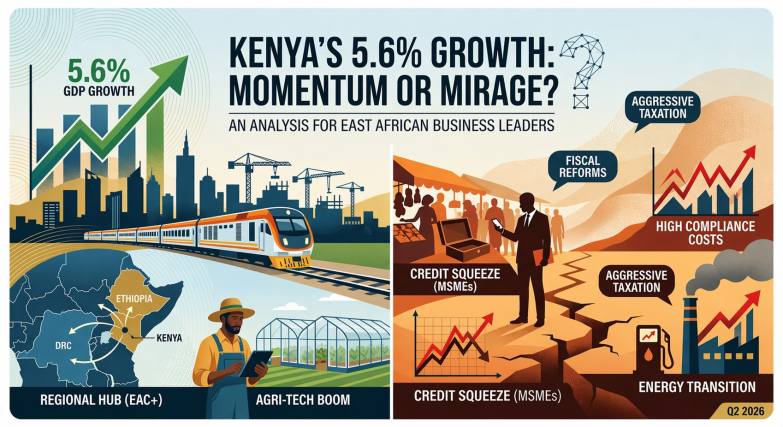

The headline figures tell a story of resilience. But for the CEO in Industrial Area or the MSME owner in downtown Nairobi, the lived reality is far more nuanced — and the decisions you make now will define the next decade.
KEY STATS (for callout boxes):
- 5.6% — GDP growth (KNBS, FY 2025)
- 17.5% — Average effective bank lending rate
- 62% — MSMEs reporting loan rejection or partial approval (CBK 2026 Survey)
Kenya’s economy has demonstrated stubborn resilience. After expanding at 5.6% in the 2025 fiscal year (KNBS Q4 2025 report), the headline figures paint a picture of a nation successfully navigating successive shocks. On paper, Kenya is a region-leading success story. But is this growth fuelled by sustainable productivity, or are we witnessing a jobless recovery masked by high-value infrastructure projects and painful fiscal tightening?
To be fair, there are real bright spots. Diaspora remittances held above $500M monthly through 2025, digital services exports continue to grow at double digits, and the tea sector has staged a genuine price recovery. The question is whether these are enough to offset the structural pressures below.
STABILITY AT A COST
Recent data from the Central Bank of Kenya (CBK) and the Kenya National Bureau of Statistics (KNBS) show inflation cooling from its 2023–2024 peaks. But structural cracks remain. The suspension of major multilateral disbursements in 2025 — including delayed IMF programme reviews and withheld World Bank budget support — forced the government into accelerated fiscal reforms. These moves stabilised the Shilling but ushered in an era of aggressive taxation (including VAT on petroleum and expanded digital service taxes) and reduced subsidies, following the phased withdrawal under the 2025 Finance Act.
For the private sector, the cost of doing business is no longer just the price of fuel. It is the cost of compliance and the shrinking disposable income of the Kenyan consumer. Both are eating into margins that were already thin.
REALITY CHECK
MSME credit access (CBK 2026 Survey): 62% of small businesses report loan rejection or partial approval. Average effective bank lending rate: ~17.5%. Working capital remains the single biggest constraint on expansion.
WHY THIS MATTERS FOR THE EAST AFRICAN EXECUTIVE
As the East African Community (EAC) continues to deepen integration — with the DRC (a member since 2022) now more closely linked through new transport corridors, and Kenya strengthening bilateral trade arrangements with Ethiopia — the country retains its position as the bloc’s logistical and financial hub. Growth is no longer confined to Nairobi; it is happening along transit corridors, in border towns, and in regional commodity markets.
Extrapolating past patterns into 2026 is no longer strategy — it’s nostalgia.
The Consumption Gap
While GDP rises, the backbone of the economy — MSMEs — continues to face a credit squeeze. High interest rates, intended to protect the currency, have made traditional bank loans a last resort. Access to working capital remains the single biggest constraint for growth-hungry small businesses.
The Energy Transition
With fuel subsidies depleted under the 2025 Finance Act’s phased withdrawal, the shift toward green energy is no longer an environmental choice — it is a balance-sheet necessity. Businesses with high energy costs that delay this transition are not just being irresponsible; they are accepting a structural competitive disadvantage.
The Regional Pivot
Deepened integration within the expanded EAC, alongside new trade frameworks with Ethiopia, opens some of the continent’s most significant frontier markets. The opportunity is real — but so is the complexity. Businesses that begin building regional supply chains and distribution networks today will be positioned to capture disproportionate gains.
*”The winners of 2026 will be those who stop waiting for the old normal to return — and start building leaner, digital-first, regionally-focused enterprises.”*
THREE STRATEGIES FOR 2026
1. Invest in Agri-Tech and Value Addition
The 5.6% growth was heavily bolstered by an agricultural rebound — but exporting raw materials is a 20th-century model. Businesses investing in local processing, turning raw tea, coffee, and macadamia into finished, branded products, are capturing the highest margins. The infrastructure is maturing; the window for early movers is now.
2. Move Beyond Digital Basics
Government investment in fibre optic infrastructure and digital hubs has reached an inflection point. Leaders should move beyond social media marketing into data-driven inventory forecasting and AI-managed supply chains. These tools meaningfully mitigate the volatility of import costs and currency exposure.
3. Explore Alternative Financing
With traditional credit expensive, 2026 is the year of green bonds and equity partnerships. Global funders are no longer evaluating companies on P&L alone — ESG scores are becoming a gateway to lower-interest climate financing. Real-world examples: FMO’s 2026 green facility for East African agribusiness and Acumen’s resilience fund targeting off-grid energy and sustainable agriculture. An efficiency upgrade in your operations could be the key that unlocks a fundamentally different cost of capital.
THE VERDICT
The 5.6% figure is a sign of momentum. But without a vibrant, liquid private sector, that momentum risks becoming a mirage. The coming months will test Kenya’s ability to translate headline growth into inclusive prosperity — and test business leaders’ willingness to build for the economy that is arriving, not the one that has passed.
━━━━━━━━━━━━━━━━━━━━━━━━━━━━━━━━━━━━━━━━━━━━━━━━━━━━━━━
CALL TO ACTION:
Is your organisation seeing this growth reflected in your order books, or are fiscal reforms still squeezing your margins? Share your perspective in the comments below, or submit a guest contribution to our business leadership series.